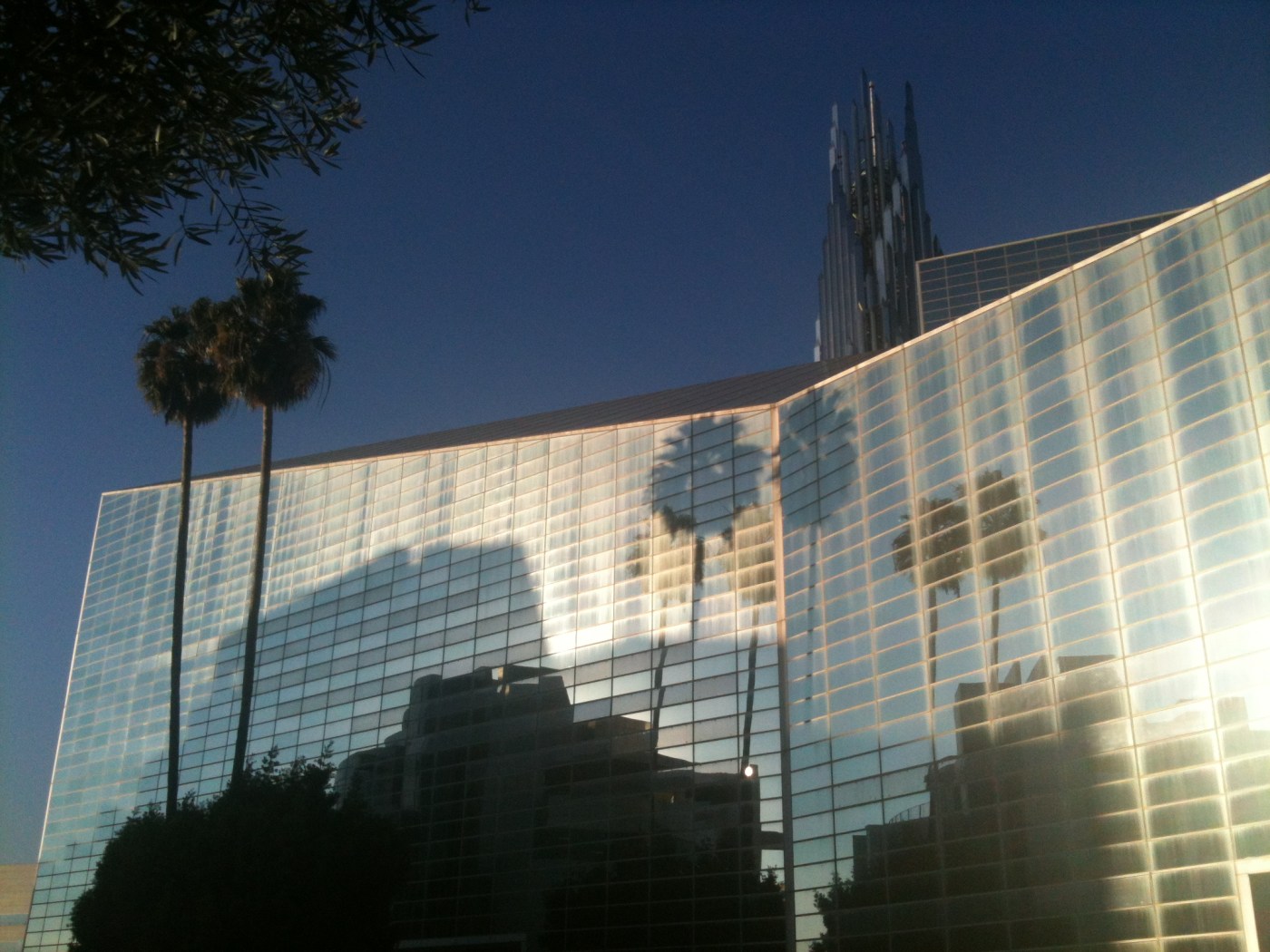
The windows of the Crystal Cathedral aren’t as shiny as they once were.
In three years, the Crystal Cathedral will be a Catholic cathedral. What is the Catholic Church getting for $57.5 million?
We’ve all seen the shining pictures of the shining cathedral, but since moving out to L.A., I’ve been really curious to see it for myself. I finally made it down to Orange County a few weeks ago. Visitors still flock to the architectural landmark, but bankrupt mega-church is showing its age.
Aside from the 236-foot bell tower, looming cross, and countless statues, the grounds resemble a confused corporate campus, with plenty of parking for commuters. At a distance from the main buildings, an uninspired boxy, white school looks as if it might hold cubicles, not classrooms.
Take off the gigantic cross, and architect Richard Neutra’s Tower of Hope is no more than what it is—an office building built in the 1960s. The curved stainless steel façade makes Richard Meier’s visitor center, completed in 2003, look like it could be the centerpiece of a technology company’s headquarters, rather than an ancillary building on church grounds.
These buildings are reflected in the windows of Philip Johnson’s all-glass cathedral, the gem of the campus. At first glance, though, even the cathedral could be a uniquely shaped 1980s office building, its dark window not revealing what’s inside.
The mish-mash of styles in the three main buildings is supposed to represent the evolution of Southern California modern architecture, but it also appropriately represents the venture of its founder, Robert Schuller, who has combined business, entertainment, and inspiration in his ministry for more than 50 years.
The Crystal Cathedral bankruptcy proceedings revealed how much business and politics go into running a church. The Crystal Cathedral at first opposed the diocese’s bid because after three years, the church couldn’t broadcast the “Hour of Power,” which bring in much of its revenue, from the cathedral. Schuller was a pioneer in combining entertainment with ministry, reaching out to the masses rather than waiting for them to come to church. He first held services in California at a drive-in theater. “Come as you are in the family car” became his tagline.
The vision he asked Johnson to create in his cathedral was one of openness—where he could see the blue sky, just as he could at the drive-in.
Today the windows of the Crystal Cathedral are slightly grimy, not shining like crystal in the afternoon sun. Inside the carpet is worn and spotted by the steps of countless visitors and worshipers. The Sony Jumbotron has nothing on the audio-visual displays of more modern mega-churches.
But as I sank into a faded blue seat—Row I, Seat 4—I could see Schuller’s original idea. The parking lot behind the Cathedral disappeared, and all I could see beyond the white lattice-structure was blue. The space simultaneously seemed small and large—a boat that can hold nearly 3,000 people, floating through the expanse of creation.
A bird flew down and landed next to the long fountain that extends down the center aisle of the church. Trees grow inside, and a volunteer set up plants along the altar.
Or perhaps it’s better called a stage. The marble front piece, after all, is the backdrop for the “Hour of Power” broadcast. A second look skywards and I noticed stage lighting hanging from the steal frame. The balcony holds not only the world’s third-largest organ but also professional studio cameras. Seating is theater-style, not pews. I knew I was in a church—there’s a cross in the corner, after all—but it doesn’t really feel like it.
It’s unclear still what the diocese means when it says that “critical design upgrades” are required. The space could benefit from a sprucing up, but I hope the diocese goes further than that. Losing the “studio” elements in the cathedral would eliminate some distractions from worship, but the rest of the campus, which is so wrapped up in Schuller’s story, needs to be considered too.
The board of the church ended up supporting the diocese bid because they wanted to see their cathedral remain a church. But is an evangelical mega-church fundamentally different from a Catholic cathedral? How can the Catholic Church make the space its own while respecting what came before?
I look forward to visiting it again in three years.
I wrote a description of the Crystal Cathedral as a part of a class I’m taking about writing about architecture, and updated it today with news of its sale. It was also posted at USCatholic.org and then quoted in a Religion News Service article posted on sites such as USA Today, Huffington Post, and Christian Century.


 Religious leaders of a variety of faith groups honored the victims of the Sept. 11, 2001, terrorist attacks in a Saturday-evening ceremony at Los Angeles City Hall with the aim of fostering interfaith activity for peace.
 Megan Sweas
Decolonizing Coverage: Religion, Celebrity and Kony 2012
Media critique for TRANS/MISSIONS, the site for the Knight Center for Media and Religion, March 26, 2012
After visiting a slum in Delhi, India with a young evangelical woman from Georgia, a friend and I got into a discussion about Americans working in the developing world. “Maybe I just don’t like NGOs,” he said, convinced that the efforts of not just evangelicals but all Westerners are tainted by a sense of cultural superiority. Continue reading “Decolonizing Coverage: Religion, Celebrity and Kony 2012” →