Edited interview published in U.S. Catholic, November 2008
 It seems that easy sex is rampant on college campuses today, but new research from feminist theologian Donna Freitas reveals that students really want romance.
Edited interview published in U.S. Catholic, November 2008
It seems that easy sex is rampant on college campuses today, but new research from feminist theologian Donna Freitas reveals that students really want romance.
Edited interview published in U.S. Catholic, August 2008
 Poverty is a global problem, and the entire human family will have to contribute to the solution, says Lesley-Anne Knight, the first female secretary general of Caritas Internationalis.
Edited interview published in U.S. Catholic, July 2008
 Young people can change the world, this Muslim interfaith organizer says. They just need a chance to share their traditions with each other.

Published in U.S. Catholic, May 2008
Honorable mention for investigative writing, Catholic Press Association
Honorable mention for feature, Associated Church Press
How family farmers are planting for a sustainable future
Russ Kremer had a near-death experience in 1989. On his central Missouri farm, he was bitten by a hog and contracted a form of strep resistant to at least five antibiotics. His hogs’ feed included antibiotics to protect them—but not humans—from disease.
Doctors cured him, but Kremer decided to start his farm operation anew, raising hogs naturally.
Photo story published in U.S. Catholic, November 2007
Catholic college students get schooled in peace and protest at the annual School of the Americas vigil.

“Close it down!” Patrick Eccles, a Loyola University Chicago chaplain, shouted to a group of 50 Loyola students about to embark on a trip to Columbus, Georgia to protest the U.S. Army School of the Americas (SOA). “Close it down,” they replied weakly, seeming unsure of their voices, mission, and comrades.
Three days and 830 miles later, the students stood in a tight circle, arms around each other, waiting to return home. After praying together—for the victims of the SOA, for the efforts to close it, and for the community formed over the weekend&mdashthey repeated the call and response. “Close it down!” they yelled unabashedly this time, turning other protesters’ heads.
The moment was spontaneous—”a positive way to keep people together” when the bus was late—says Rachel Hart, a chaplain and trip organizer. Yet after a transformative weekend that was part spiritual retreat, part social action, and part community building, it was an appropriate “sending forth.”
“There was a community and a spirit of the group that didn’t just end in Georgia,” Hart says. …
PDF of “Basic training” (includes photography)
Published in U.S. Catholic, July 2007
Former full-time volunteers confess that their experiences change them for good.
 “This feels like a homecoming,” Beth Knobbe told a retreat group of both new and familiar faces-30 of her fellow alumni from Amate House, a Catholic lay volunteer program in Chicago. Knobbe actually lived with just a few of the retreatants when they were part of the program. Most of the alumni on the retreat were more recent Amate graduates, including eight who had just completed their service year in 2006, 10 years after Knobbe had finished hers. Still, Knobbe immediately felt connected to these young adults, who knew what the full-time volunteer experience was all about.
“All of us can admit that an experience like Amate changes us,” Knobbe said. “We use that wonderful phrase ‘ruined for life,’ which is to say, ‘you will never be the same.'” …
Following Pope Benedict XVI’s controversial remarks on Islam at the University of Regensburg in September 2007, U.S. Catholic published a series of articles about Muslim-Catholic dialogue. The February 2007 special section featured an interview of two experts in interreligious dialogue, a scholarly essay about the history of the relationship between the two religions, and this story on ordinary Muslims and Catholics seeking understanding:
Won’t you be my neighbor? (U.S. Catholic, February 2007)
Friendly meetings between Catholics and Muslims can make it a beautiful day in the neighborhood for all God’s children.

A couple of Muslim children-fourth- or fifth-graders probably-squirmed and whispered to each other in the middle of midday prayer at the Muslim-American Youth Academy (MAYA) in Dearborn, Michigan.
Teachers from St. Paul Catholic School in Grosse Pointe Farms, Michigan were not surprised. “They’re just like our students,” they commented. During their visit to MAYA and the Islamic Center of America, St. Paul students, too, found that the Muslim children are not unlike them: Not only do they all have school uniforms, but they all worship the God of Abraham.
“Some of the students had the idea that Muslims were terrorists, and there was some fear. That was completely gone after the trip,” says St. Paul principal Mary Miller. …
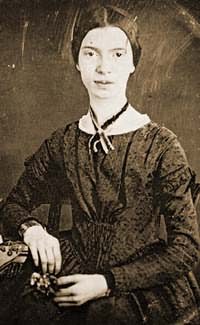
Perhaps the only poem that I can still recite from memory is Emily Dickinson’s “I’m Nobody.” I learned it in junior high and it stuck with me:
I’m Nobody! Who are you?
Are you – Nobody – too?
Then there’s a pair of us?
Don’t tell! they’d advertise – you know! Continue reading “I’m Nobody”

 Megan Sweas